
Yemen Condemns Iranian Attacks on Kuwait, Bahrain and UAE Oil Tanker
The Republic of Yemen has condemned repeated Iranian attacks on Kuwait and Bahrain, as well as an attack on an oil tanker belonging to the United Arab Emirates, describing them as flagrant violations of the sovereignty and territorial integrity of the countries concerned.
GCC Secretary-General Welcomes UN Security Council’s Position on Houthi Attacks Against Saudi Arabia
The Secretary-General of the Gulf Cooperation Council (GCC) Jasem Albudaiwi has expressed his appreciation for the position conveyed by members of the United Nations Security Council in their presidential statement regarding the attacks carried out by the Houthi terrorist militia against the Kingdom of Saudi Arabia.

EU Allocates 525 Million Euros to Support Startups in Chip Design
European Commissioner for Technological Sovereignty, Security and Democracy, Hana Verkonen, announced that the European Union (EU) has allocated 525 million euros to support startups in the field of chip design.

Al Nassr Beat Al Fateh 3-0 in Saudi Football League
Al Nassr defeated Al Fateh 3-0 in the opening round of the Saudi Pro League, known as the Roshn Saudi League.
Last Update: ،
2026/11/18
Time
03:25:27
Latest News:
 Yemen Stresses Climate Adaptation, Calls for Increased Funding for Conflict-Affected Countries
Foreign Minister Briefs Arab Ambassadors in Netherlands on Developments in Yemen
Minister of Local Administration Seeks U.S. Support for Ministry
Water Minister Discusses Research Cooperation to Address Climate-Related Displacement in Yemen
Technical Education Minister Meets Chinese Embassy Chargé d’Affaires
Latest News:
Yemen Stresses Climate Adaptation, Calls for Increased Funding for Conflict-Affected Countries
Foreign Minister Briefs Arab Ambassadors in Netherlands on Developments in Yemen
Minister of Local Administration Seeks U.S. Support for Ministry
Water Minister Discusses Research Cooperation to Address Climate-Related Displacement in Yemen
Technical Education Minister Meets Chinese Embassy Chargé d’Affaires
Yemen Stresses Climate Adaptation, Calls for Increased Funding for Conflict-Affected Countries
[18/11/2026 03:14]
ANTALYA-SABA
Yemen has reaffirmed its commitment to climate action and the implementation of its obligations under the Paris Agreement, stressing the need to make climate adaptation central to economic recovery and development efforts and strengthen the resilience of communities and national institutions to climate change.
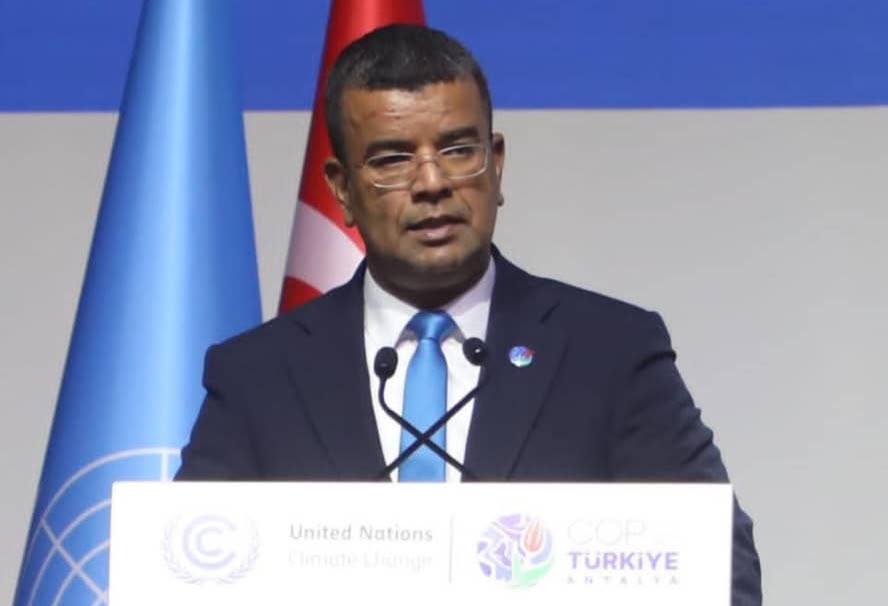
The position was delivered by General Authority for Environmental Protection Chairman Fahmi bin Shubraq at the high-level ministerial meeting of the 31st UN Climate Change Conference (COP31), held in the Turkish city of Antalya.
In his address, bin Shubraq outlined the overlapping challenges posed by conflict and climate change and their impact on natural resources, food security, livelihoods and essential services.
He said nearly half of Yemen's population faces exposure to at least one major climate hazard, warning that climate change could reduce annual GDP by an average of 3.9 percent by 2040. By contrast, investment in water management and climate-resilient agriculture could increase the productivity of major crops by up to 13.5 percent between 2041 and 2050.
Despite the consequences of the conflict, he said, the Yemeni government continues efforts to restore state institutions, improve public services, implement reforms and pursue development projects in cooperation with its partners. He stressed that protecting Yemen's future depends on expanding opportunities for its people in employment, education and development.
Bin Shubraq also highlighted Yemen's third Nationally Determined Contribution (NDC 3.0), which provides a framework for aligning climate action with development and recovery priorities through 2035.
The framework is built around five pillars: integrating climate considerations into development and recovery plans; prioritizing adaptation and resilience-building; promoting a resilient, low-emission economy; ensuring inclusion, equity and local participation; and mobilizing finance, technology transfer and innovation.
He stressed that fulfilling climate commitments requires adequate and sustainable financing, technology transfer and stronger national institutional capacities.
He called for increased climate finance for developing countries affected by conflict, alongside dedicated and simplified access to funding that reflects the scale of the risks and needs they face.
He also urged faster delivery on the new collective quantified climate finance goal of at least $300 billion annually by 2035, fulfillment of commitments to double adaptation finance and increase it at least threefold by the same year, and the provision of adequate, sustainable resources to the Loss and Damage Fund, with easier access for the most vulnerable countries.
Investing in Yemen's resilience, institutions and economy would also contribute to regional stability and protect shared interests, bin Shubraq said, calling for international partnerships that translate climate commitments into faster access to finance, broader adaptation efforts and a more equitable transition, ensuring that the most affected communities are not left behind.
Key words:
implementation - considerations - SABA Yemen - Investing - Environmental - institutional - opportunities - participation - international - prioritizing -
Yemen Condemns Iranian Attacks on Kuwait, Bahrain and UAE Oil Tanker
Yemen Stresses Climate Adaptation, Calls for Increased Funding for Conflict-Affected Countries
Minister of Local Administration Seeks U.S. Support for Ministry
Vice Foreign Minister Meets UNVIM Director in Djibouti
Parliament Speaker Submits Houthi Terrorist Designation Law to President
Minister of Water and Environment Reviews Yemen’s Climate Action
Taiz Governor: Food Stocks Cover Only 10% of Residents’ Needs as Supplies Plummet
Parliament Approves Law of Designating Houthi Group Terrorist Organization, Criminalizing its Activities, Funding
Coalition Intercepts and Destroys Two Houthi Drones Over Makkah and Riyadh
Rights Group Documents 319 Civilian Casualties in Houthi Violations in Taiz