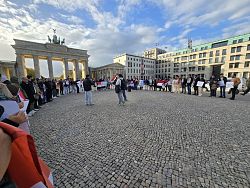
Berlin Protest Calls for Lifting Taiz Siege, Designating Houthis as Terrorists
Members of the Yemeni community in Berlin staged a protest calling on Germany, the European Union, the United Nations and the international community to pressure the Iran-backed Houthi militia to lift the siege on Taiz, reopen roads, ensure freedom of movement and allow humanitarian supplies into the city.

GCC Secretary-General Welcomes UN Security Council’s Position on Houthi Attacks Against Saudi Arabia
The Secretary-General of the Gulf Cooperation Council (GCC) Jasem Albudaiwi has expressed his appreciation for the position conveyed by members of the United Nations Security Council in their presidential statement regarding the attacks carried out by the Houthi terrorist militia against the Kingdom of Saudi Arabia.

Brent Crude Futures Rise 12 Cents
Oil prices remained mostly unchanged in early Asian trading on Thursday following gains from the previous session and a sharp monthly increase.

Al Nassr Beat Al Fateh 3-0 in Saudi Football League
Al Nassr defeated Al Fateh 3-0 in the opening round of the Saudi Pro League, known as the Roshn Saudi League.
Last Update: ،
2026/10/26
Time
07:22:51
Latest News:
 Berlin Protest Calls for Lifting Taiz Siege, Designating Houthis as Terrorists
Coalition Carries Out Operation to Neutralize Houthi Threats
Yemen’s Human Rights Ministry Warns of Humanitarian Catastrophe in Taiz
Citizen Killed by Houthi Landmine Explosion in Al-Baydha Governorate
Yemen Condemns Israeli National Security Minister’s Incursion into Al-Aqsa Mosque
Latest News:
Berlin Protest Calls for Lifting Taiz Siege, Designating Houthis as Terrorists
Coalition Carries Out Operation to Neutralize Houthi Threats
Yemen’s Human Rights Ministry Warns of Humanitarian Catastrophe in Taiz
Citizen Killed by Houthi Landmine Explosion in Al-Baydha Governorate
Yemen Condemns Israeli National Security Minister’s Incursion into Al-Aqsa Mosque
Yemeni Rights Network Documents 42 Houthi Violations in Taiz in 48 Hours
[26/10/2026 06:33]

ADEN-SABA
The Yemeni Network for Rights and Freedoms has documented 42 crimes and violations committed by the Iran-backed Houthi militias in Taiz over the past 48 hours, including the firing of around 369 projectiles at residential areas, killing four civilians and injuring seven others, including two 14-year-old girls.
In a report released Monday, the network said the violations occurred amid an ongoing siege that obstructs the delivery of medicines, fuel and essential supplies.
The documented violations included the abduction of eight residents from their homes and shops in al-Kulaibah area of al-Ma'afer district and their transfer to al-Saleh City. One was lured under the pretext of a general amnesty. The report also documented raids, intimidation, pressure to recruit dozens of local residents, the looting of eight homes, attacks on houses in al-Aqroudh, and the raiding and looting of Colonel Taha al-Qudsi's home in al-Batnah village, Quds district, al-Mawaset. Houthi shelling also damaged the southern side of Fouad al-Tabouki's house in Ras al-Naqil, al-Aqroudh, after it was targeted from al-Manarah Hill.
The network warned that the siege and shortages of medical supplies threaten the lives of 1,280 kidney failure patients who require 140 dialysis sessions daily. Fuel and medical shortages also endanger 192 intensive care patients and 154 infants in incubators.
The report documented damage to two hospitals, four medical centers and three medical warehouses, including al-Safwa Hospital, which serves more than 50,000 patients. It said 42 health facilities face severe shortages of supplies, while hospitals and ambulances require more than 156,000 liters of fuel monthly to maintain services. Power cuts and the failure of generators have further disrupted medical care.
The siege has also deprived patients of essential and life-saving medicines for diabetes, kidney failure, emergencies, hemophilia, thalassemia, sickle cell disease, mental and neurological disorders, epilepsy, Parkinson's disease, kidney infections, lupus and Behçet's disease. Services for tuberculosis patients and malnourished children have also been disrupted.
The report said 20 percent of maternity and prenatal care clinics had closed, depriving 734 women of delivery services and medical supervision. Family planning, screening and maternal and child health services have also been disrupted.
Vaccination centers have stopped operating, leaving 3,600 children without immunization. Services for BCG, pentavalent, rotavirus, tetanus and polio vaccines have been suspended, alongside shortages of injection supplies and vaccination cards.
Around 45,678 people, including women and children, have also been deprived of malaria testing, undermining disease prevention efforts and increasing health risks in the conflict-affected governorate.
Hospitals in Taiz receive around eight cases daily, but shelling obstructs patients' and casualties' access to medical facilities, while shortages of medicines and power further undermine the capacity of functioning hospitals to respond.
The network also reported that shelling and sniper fire have obstructed municipal sanitation workers and endangered their lives, leading to accumulated waste and an increase in insects. Sewage has overflowed onto Jamal, al-Tahrir, Wadi al-Qadi and Bir Pasha streets, mixing with waste in the drainage channel toward Osaifirah.
According to health data cited in the report, the siege has caused the deaths of six dialysis patients, while two medical workers have been killed and four others injured. Two ambulances have also been targeted with mortar shells and drones, as access to the wounded and their evacuation continue to be obstructed.
The network called for an end to attacks on civilians and health facilities, the lifting of the siege, the reopening of roads, and the safe passage of ambulances, medicines, fuel and humanitarian aid. It urged the United Nations, international organizations and partners to intervene urgently to restore suspended health services and support maternal and child care, vaccination, dialysis and environmental sanitation.
The network warned that the escalation is pushing Taiz, home to around four million people, toward a worsening humanitarian crisis marked by killings, shelling, abductions and home looting, alongside collapsing health services, water shortages and deteriorating environmental conditions. It stressed that urgent action is needed to protect civilians and maintain essential services, warning that continued attacks and the siege would deepen the crisis, with children, women and patients bearing the heaviest burden.
Key words:
Vaccination - international - According - environmental - Hospitals - organizations - deteriorating - humanitarian - intimidation - malnourished -
Yemeni Rights Network Documents 42 Houthi Violations in Taiz in 48 Hours
Berlin Protest Calls for Lifting Taiz Siege, Designating Houthis as Terrorists
Coalition Carries Out Operation to Neutralize Houthi Threats
Yemen’s Human Rights Ministry Warns of Humanitarian Catastrophe in Taiz
Citizen Killed by Houthi Landmine Explosion in Al-Baydha Governorate
Yemen Condemns Israeli National Security Minister’s Incursion into Al-Aqsa Mosque
Prime Minister Discusses Houthi Escalation, Attacks on Civilians, Taiz Siege with EU Mission's Ambassador
Al-Barkani Informs Chairman of Pakistan's National Assembly on Developments in Yemen
Yemen Participates in 17th Session of Arab Ministerial Water Council
Houthi Shelling Kills Child in Southern Taiz