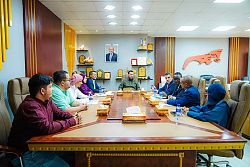
Aden Governor Discusses with UNICEF Strengthening Interventions in Water, Education
Aden Governor, the Minister of State Abdulrahman Sheikh met on Tuesday with UNICEF Deputy Representative in Yemen Obia Ashing, discussing with him strengthening the organization’s support for local authorities in key sectors.

GCC Secretary-General Welcomes UN Security Council’s Position on Houthi Attacks Against Saudi Arabia
The Secretary-General of the Gulf Cooperation Council (GCC) Jasem Albudaiwi has expressed his appreciation for the position conveyed by members of the United Nations Security Council in their presidential statement regarding the attacks carried out by the Houthi terrorist militia against the Kingdom of Saudi Arabia.

Brent Crude Futures Rise 12 Cents
Oil prices remained mostly unchanged in early Asian trading on Thursday following gains from the previous session and a sharp monthly increase.

Al Nassr Beat Al Fateh 3-0 in Saudi Football League
Al Nassr defeated Al Fateh 3-0 in the opening round of the Saudi Pro League, known as the Roshn Saudi League.
Last Update: ،
2026/10/27
Time
06:39:37
Latest News:
 Green Climate Fund Approves Project Worth $28 Million to Develop 'CWIMEWS' in Yemen
Yemen, China Discuss Development and Humanitarian Cooperation
President al-Alimi Calls on Europe to Designate Houthis as Terrorist Organization
Report Documents Houthi Violations Against 107 Women and Children in Taiz
Yemenia Aircraft Makes Safe Landing in Jordan After Hail Strike
Latest News:
Green Climate Fund Approves Project Worth $28 Million to Develop 'CWIMEWS' in Yemen
Yemen, China Discuss Development and Humanitarian Cooperation
President al-Alimi Calls on Europe to Designate Houthis as Terrorist Organization
Report Documents Houthi Violations Against 107 Women and Children in Taiz
Yemenia Aircraft Makes Safe Landing in Jordan After Hail Strike
Yemen's stability linked to 3 peace references, says human rights minister
[28/07/2019 01:22]

CAIRO-SABA
Minister of Human Rights Mohammed Askar said Yemen's sought-after stability is "linked to implementing the three terms of reference for peace first.
Addressing a human rights conference in Cairo on Sunday, Askar was referring to the GCC Agreement of 2011, the outcomes of the National Dialogue Conference of 2014 and the UN Security Council resolution 2216 (2015).
"For four years, Yemen has been facing challenges that impact the pan-Arab security," he said. "Despite the humanitarian and economic crises it is enduring, Yemen, by all its stakeholders, is facing the most dangerous rebel guerilla that had seized the state weapons making use of their infiltrators in the army with a military planning and support from Iran."
He cited the Houthi recruitment of young generations to the battlefield, detonation of houses, and killings and mutilations of opponents as signs of the Houthi criminality.
The minister warned that abandoning Yemen "will have serious consequences on the regional and international shipping." He especially warned of the Houthi amassing of thousands of children in a compulsory way to sectarian radicalization camps before deploying them to pursue death in the name of martyrdom.
Minister of Human Rights Mohammed Askar said Yemen's sought-after stability is "linked to implementing the three terms of reference for peace first.
Addressing a human rights conference in Cairo on Sunday, Askar was referring to the GCC Agreement of 2011, the outcomes of the National Dialogue Conference of 2014 and the UN Security Council resolution 2216 (2015).
"For four years, Yemen has been facing challenges that impact the pan-Arab security," he said. "Despite the humanitarian and economic crises it is enduring, Yemen, by all its stakeholders, is facing the most dangerous rebel guerilla that had seized the state weapons making use of their infiltrators in the army with a military planning and support from Iran."
He cited the Houthi recruitment of young generations to the battlefield, detonation of houses, and killings and mutilations of opponents as signs of the Houthi criminality.
The minister warned that abandoning Yemen "will have serious consequences on the regional and international shipping." He especially warned of the Houthi amassing of thousands of children in a compulsory way to sectarian radicalization camps before deploying them to pursue death in the name of martyrdom.
Key words:
SABA Minister - radicalization - Addressing - international - infiltrators - implementing - humanitarian - stakeholders - consequences - recruitment -
Green Climate Fund Approves Project Worth $28 Million to Develop 'CWIMEWS' in Yemen
Yemen, China Discuss Development and Humanitarian Cooperation
Report Documents Houthi Violations Against 107 Women and Children in Taiz
Coalition Intercepts and Destroys Four Drones and Three Ballistic Missiles Launched by Houthis Toward Saudi Arabia
Berlin Protest Calls for Lifting Taiz Siege, Designating Houthis as Terrorists
Yemen’s Human Rights Ministry Warns of Humanitarian Catastrophe in Taiz
Al-Barkani Informs Chairman of Pakistan's National Assembly on Developments in Yemen
Yemen Participates in 17th Session of Arab Ministerial Water Council
Houthi Shelling Kills Child in Southern Taiz
Aden Governor Discusses Humanitarian Cooperation and Sustainable Development Projects with UN OCHA