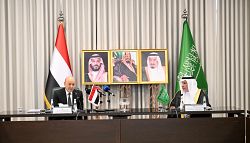
President al-Alimi Launches Package of Relief Projects from King Salman Center to Support Taiz's Resilience, Help those Affected Across Yemen
His Excellency President Dr. Rashad al-Alimi, Chairman of the Presidential Leadership Council (PLC), visited today, Tuesday the King Salman Center for Relief and Humanitarian Work. He was received by Dr. Abdullah al-Rabeeah, Advisor at the Royal Court and General Supervisor of the Center, Saudi Arabia's Ambassador to Yemen, Mohammed al-Jaber, along with several leaders of the center and its partners in relief and humanitarian work.
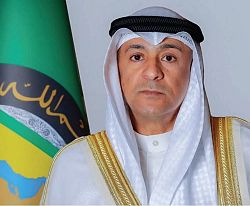
GCC Secretary-General Welcomes UN Security Council’s Position on Houthi Attacks Against Saudi Arabia
The Secretary-General of the Gulf Cooperation Council (GCC) Jasem Albudaiwi has expressed his appreciation for the position conveyed by members of the United Nations Security Council in their presidential statement regarding the attacks carried out by the Houthi terrorist militia against the Kingdom of Saudi Arabia.

Brent Crude Futures Rise 12 Cents
Oil prices remained mostly unchanged in early Asian trading on Thursday following gains from the previous session and a sharp monthly increase.

Al Nassr Beat Al Fateh 3-0 in Saudi Football League
Al Nassr defeated Al Fateh 3-0 in the opening round of the Saudi Pro League, known as the Roshn Saudi League.
Last Update: ،
2026/10/28
Time
12:50:12
Latest News:
 Yemeni Ambassador Discusses Developments in Yemen with Czech Parliament Speaker
Aden Governor Discusses with UNICEF Strengthening Interventions in Water, Education
Green Climate Fund Approves Project Worth $28 Million to Develop 'CWIMEWS' in Yemen
Yemen, China Discuss Development and Humanitarian Cooperation
President al-Alimi Calls on Europe to Designate Houthis as Terrorist Organization
Latest News:
Yemeni Ambassador Discusses Developments in Yemen with Czech Parliament Speaker
Aden Governor Discusses with UNICEF Strengthening Interventions in Water, Education
Green Climate Fund Approves Project Worth $28 Million to Develop 'CWIMEWS' in Yemen
Yemen, China Discuss Development and Humanitarian Cooperation
President al-Alimi Calls on Europe to Designate Houthis as Terrorist Organization
Yemen commemorates Day of Revolution against theocratic tyrants
[26/09/2020 10:10]

PROVINCES-SABA
Yemen has widely commemorated on Friday night the Day of Revolution against the pre-1962 theocratic Mutawikili Imams, the ancestors of present-day Houthi rebels who plunged Yemen in a devastating six year war.
The people and local governments in Marib, Shabwa, Sana’a outskirts, Saadah, and Hajjah and officials in Yemeni embassies abroad lit the symbolic torch to mark the victory of Yemen against the overly racist and corrupt regime.
The perverted form (Zaydi Imami) of Islam which the Imamite draws from limits the right of government to what it calls “Al-Batnayn”, the offspring of prophet Mohammed through his grandchildren Al-Hassan and Al-Hussein.
Lighting the torch in Nehm fronts near Sana’a, senior army commander Maj. Gen. Ameen al-Wa’ili said, “The war the Houthi militia ignited in Yemen was primarily aimed to take revenge for the 26th September revolution and to return Yemen back to square zero to undergo oppression and deprivation under theocratic rule.”
“We are following the footsteps of the 26 September Revolution fighters until we rid Yemen of the bigoted followers of theocracy and the hunger, illiteracy and pandemics they have brought to our country back again.”
Yemen has widely commemorated on Friday night the Day of Revolution against the pre-1962 theocratic Mutawikili Imams, the ancestors of present-day Houthi rebels who plunged Yemen in a devastating six year war.
The people and local governments in Marib, Shabwa, Sana’a outskirts, Saadah, and Hajjah and officials in Yemeni embassies abroad lit the symbolic torch to mark the victory of Yemen against the overly racist and corrupt regime.
The perverted form (Zaydi Imami) of Islam which the Imamite draws from limits the right of government to what it calls “Al-Batnayn”, the offspring of prophet Mohammed through his grandchildren Al-Hassan and Al-Hussein.
Lighting the torch in Nehm fronts near Sana’a, senior army commander Maj. Gen. Ameen al-Wa’ili said, “The war the Houthi militia ignited in Yemen was primarily aimed to take revenge for the 26th September revolution and to return Yemen back to square zero to undergo oppression and deprivation under theocratic rule.”
“We are following the footsteps of the 26 September Revolution fighters until we rid Yemen of the bigoted followers of theocracy and the hunger, illiteracy and pandemics they have brought to our country back again.”
Key words:
grandchildren - commemorated - ” “We - Lighting - SABA Yemen - deprivation - governments - devastating - Revolution - theocratic -
President al-Alimi Launches Package of Relief Projects from King Salman Center to Support Taiz's Resilience, Help those Affected Across Yemen
Yemeni Ambassador Discusses Developments in Yemen with Czech Parliament Speaker
Aden Governor Discusses with UNICEF Strengthening Interventions in Water, Education
Green Climate Fund Approves Project Worth $28 Million to Develop 'CWIMEWS' in Yemen
Yemen, China Discuss Development and Humanitarian Cooperation
President al-Alimi Calls on Europe to Designate Houthis as Terrorist Organization
Report Documents Houthi Violations Against 107 Women and Children in Taiz
Yemenia Aircraft Makes Safe Landing in Jordan After Hail Strike
Coalition Intercepts and Destroys Four Drones and Three Ballistic Missiles Launched by Houthis Toward Saudi Arabia
Yemeni Rights Network Documents 42 Houthi Violations in Taiz in 48 Hours