President al-Alim: We're determined to protect civilians, correct course of partnership within Coalition to support Legitimacy
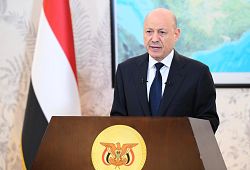
His Excellency (HE) President Dr. Rashad a-Alimi, Chairman of the Presidential Leadership Council (PLC), affirmed that the state is determined to protect civilians, uphold its legal standing and maintain unity in its military and security decisions, warning of the danger posed by the escalation of the South Transitional Council (STC) in Hadramout and al-Mahra governorates and the involvement of the United Arab Emirates (UAE) in supporting the rebellion and undermining state institutions.

Massive 7.0 Magnitude Earthquake Strikes Alaska, USA
A powerful 7.0 magnitude earthquake struck Alaska, USA, yesterday evening, according to the United States Geological Survey (USGS).

China's ETF market hits record $855.6
The combined scale of China's exchange-traded funds (ETFs) has hit a record 6.02 trillion yuan ($855.6 billion), up more than 2.2 trillion yuan from the end of last year, Shanghai Securities News reported Saturday, citing data from Choice, a financial information provider.

Arsenal defeats Brighton and strengthens its lead in the English Premier League
Arsenal defeated Brighton 2-1 in their match at the Emirates Stadium as part of the 18th round of the English Premier League.
Last Update: ،
2025/12/30
Time
10:37:40
Latest News:
 Yemen Orders UAE Forces to Withdraw Amid Rising Tensions
A republican decree about declaring a state of emergency
President al-Alim: We're determined to protect civilians, correct course of partnership within Coalition ..
Interior Ministry Supports President's Decisions to Counter Armed Rebellion
Coalition Conducts Limited Airstrike on Weapons Shipment at Yemen's Mukalla Port
Latest News:
Yemen Orders UAE Forces to Withdraw Amid Rising Tensions
A republican decree about declaring a state of emergency
President al-Alim: We're determined to protect civilians, correct course of partnership within Coalition ..
Interior Ministry Supports President's Decisions to Counter Armed Rebellion
Coalition Conducts Limited Airstrike on Weapons Shipment at Yemen's Mukalla Port
President al-Alimi urges international community to help translate sovereign decisions into practical measures within the Security Council
[30/12/2025 08:51]

RIYADH-SABA
His Excellency President Dr. Rashad al-Alimi, Chairman of the Presidential Leadership Council (PLC) met today, Tuesday, with the Ambassadors of the countries sponsoring the political process in Yemen.
The meeting aimed to discuss the latest developments in the Yemeni national arena, namely in the eastern governorates, which necessitated taking a series of firm constitutional and legal decisions and measures to protect the security of citizens, preserve Yemen's unity, sovereignty, stability and territorial integrity, and maintain the state's legal position.
The President restated that these developments were not an internal political dispute, but rather a threat to the unity of military and security decision-making, an undermining of the legal standing of the state and a reproduction of the logic of parallel authorities rejected by the international community in all its statements and resolutions.
He recounted all the commendable efforts and initiatives undertaken throughout the past period to achieve calm, de-escalate tensions and contain the repercussions of the unilateral military measures taken by the Southern Transitional Council (STC) in Hadhramaut and al-Mahra governorates outside the frameworks of the transitional phase, without the approval of the PLC or coordination with the Coalition leadership, noting that all these efforts were met with obstruction.
The President made clear that, in his capacity as the Commander-in-Chief of the Armed Forces, he explicitly ordered to stop any military movements outside the framework of the state. A three-phase plan for the gradual repositioning of the Homeland Shield forces was approved, of which two phases have already been implemented.
He said, "We created a high-level communication committee to contain the escalation and open channels of dialogue, but unfortunately, these efforts were also met with obstruction and insistence on proceeding with unilateral measures."
He stressed that this confirms that the problem was never a lack of solutions, but a deliberate obstruction of them.
The President refuted the misleading narratives aimed at justifying the imposition of a fait accompli by force under the pretext of combating terrorism, stressing that fighting terrorism is a state decision, not a political excuse.
He noted that Yemeni military and security institutions have, in recent years, with the support of their partners, achieved documented acheivements in dismantling terrorist cells, cutting off their funding sources, securing cities and vital corridors, and combating arms and drug smuggling.
He added, therefore, that the issue of terrorism cannot be used to justify military actions outside the framework of the state or to undermine its legitimate institutions.
The President reaffirmed the principled and consistent stance on resolving the Southern issue, in a just manner according to any options decided by the free will of the people. However, he firmly rejected imposing this solution by force of fact or by arms.
He stated that reducing the Southern issue to exclusive representation or military movements harms its fairness, undermines the chances of a sustainable political solution, and affects the people of the South more than anyone else.
The President explained that this stance aligns with what our brothers in the Kingdom of Saudi Arabia have confirmed, that the Southern issue is a just cause with its historical and social dimensions, and can only be resolved at the negotiating table within a comprehensive political solution.
The President touched on the Emirati role in the recent developments in the eastern governorates, saying, 'We do not deny the previous role of the UAE, nor its contributions in earlier stages, but he emphasized that what we need today is clarity and refraining from supporting a component that has deviated from the consensus mechanisms that the UAE itself sponsored within the Coalition to Support Legitimacy.'
He explained "When the Coalition to Support Legitimacy, of which we are a part, announces that there is Emirati pressure to push local forces to take military action, and that this poses a threat to Yemeni and Saudi national security and contradicts the principles on which the coalition was founded, it is my duty as the head of a UN member state to deal with this matter with the utmost seriousness and responsibility".
The Chairman of the PLC called on the countries sponsoring the political process in Yemen to take a unified and explicit international stance that rejects unilateral measures, supports the decisions of the Yemeni state and the de-escalation efforts led by the Kingdom of Saudi Arabia.
He also called for political and legal pressure to enable the legitimate government to exercise its exclusive authorities and implement the resolutions of today within the Security Council and international forums, in accordance with international law.


Key words:
responsibility" - constitutional - representation - contributions - repositioning - unfortunately - international - comprehensive - communication - repercussions -
President al-Alim: We're determined to protect civilians, correct course of partnership within Coalition to support Legitimacy
President al-Alimi urges international community to help translate sovereign decisions into practical measures within the Security Council
A republican decree about declaring a state of emergency
National Defense Council blesses presidential decisions to protect civilians, end Emirati presence in Yemen
President al-Alimi highly appreciates Saudi-Emirati ongoing mediation to de-escalation in eastern governorates
Leadership Council Chairman Presides Over Meeting of National Defense Council
President al-Alimi exalts prisoner-release agreement
President al-Alimi praises UN Security Council statement, affirms commitment to protect state legal status
President al-Alimi meets with Consultations and Reconciliation Commission headship
President al-Alimi sets out guidelines for Yemeni diplomatic missions discourse