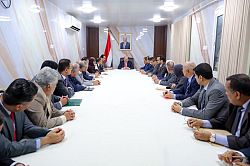
Cabinet Reviews Houthi Escalation, Calls for Stronger Response
Prime Minister Shaya Zindani chaired a Cabinet meeting in Aden on Tuesday to assess the latest Houthi military escalation and its security, economic and humanitarian consequences.

Helicopter Crashes While Fighting Wildfire in Utah
A helicopter crashed Saturday while taking part in firefighting efforts against a large wildfire in the U.S. state of Utah, with no immediate information available on the condition of the two people aboard.

Gold Edges Higher Ahead of U.S. Jobs Data
Gold prices edged higher on Tuesday as investors awaited a series of U.S. labor market reports for fresh signals on the future path of U.S. interest rates.

England Claim FIFA World Cup 2026 Bronze with Victory over France
England secured third place at the 2026 FIFA World Cup after defeating France 6-4 in the third-place playoff on Saturday.
Last Update: ،
2026/08/11
Time
08:29:33
Latest News:
 Cabinet Reviews Houthi Escalation, Calls for Stronger Response
Yemen Receives Solar-Powered Vaccine Equipment to Strengthen Immunization
Yemen Condemns Colombia’s Recognition of Claimed Israeli Sovereignty Over Occupied Syrian Golan
Transport Ministry: Houthi Attack on Yemeni Cargo Ship in Bab al-Mandab Kills Four
Foreign Ministry: Houthi Militia's Attack on Tahama Vessel Is Part of Systematic Campaign Against National ..
Latest News:
Cabinet Reviews Houthi Escalation, Calls for Stronger Response
Yemen Receives Solar-Powered Vaccine Equipment to Strengthen Immunization
Yemen Condemns Colombia’s Recognition of Claimed Israeli Sovereignty Over Occupied Syrian Golan
Transport Ministry: Houthi Attack on Yemeni Cargo Ship in Bab al-Mandab Kills Four
Foreign Ministry: Houthi Militia's Attack on Tahama Vessel Is Part of Systematic Campaign Against National ..
PM: Peace strategic choice for government, but there is no reliable partner
[28/09/2025 01:38]
ADEN-SABA
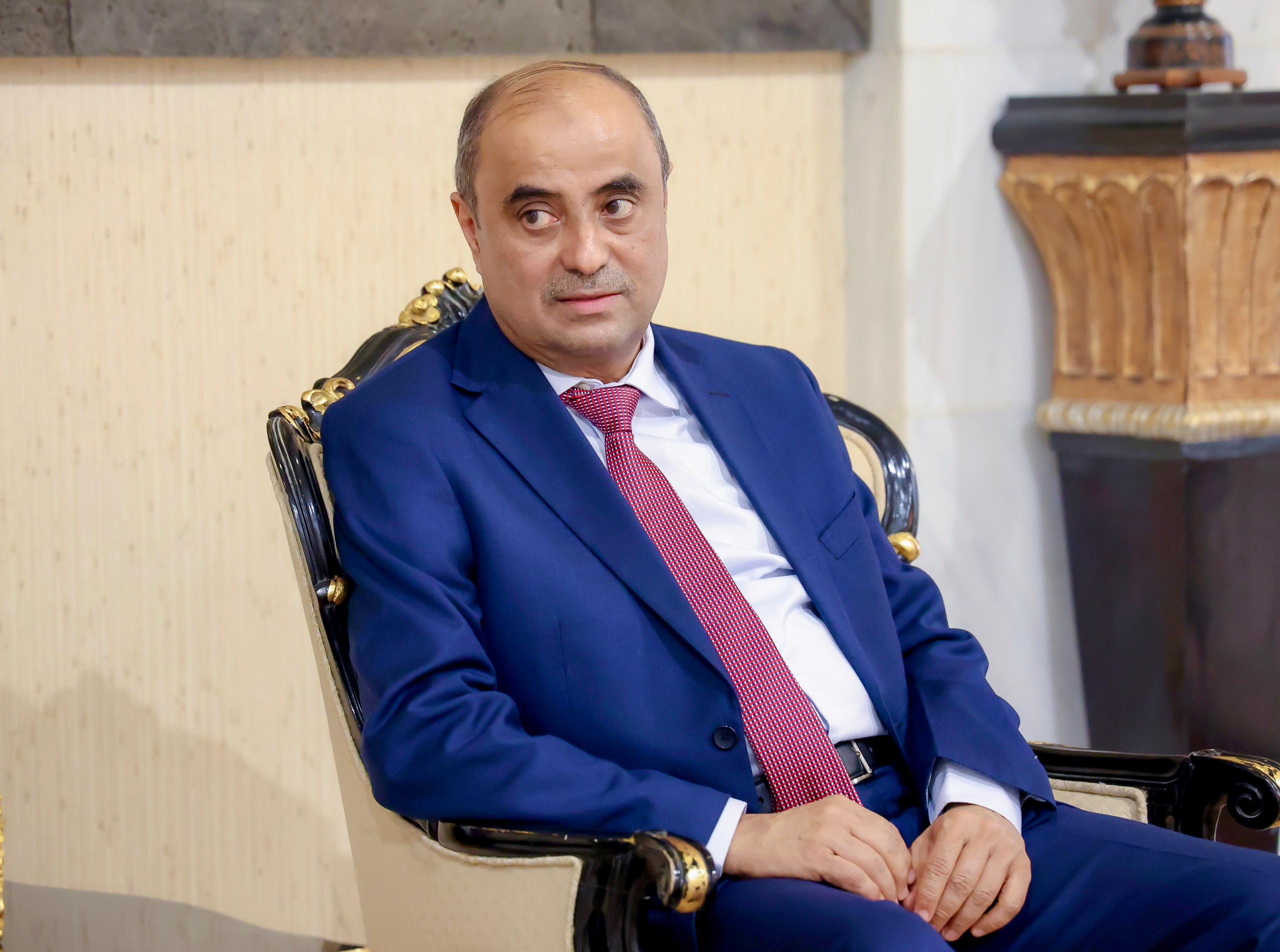
The Prime Minister Salem bin Braik stated that the recent improvement in the exchange rate of the national currency was not a coincidence, but rather the result of the integration of financial and monetary policies adopted by the government in coordination with the Central Bank of Yemen (CBY).
In an interview with the newspaper 'Asharq al-Awsat' published in its issue today, Sunday, he explained that the currency does not improve through slogans, but through difficult decisions and fiscal discipline.
He said "We have succeeded in curbing speculation, regulating the market, efficiently managing limited resources and imposing transparent mechanisms for financing imports."
He went on saying "among the measures taken by the government are the formation of the National Committee for Regulating and Financing Imports, the prohibition of dealing in foreign currencies in the domestic market, rationalizing public spending and enhancing revenues, activating monitoring and transparency tools".
Bin Braik explained that these measures have led to a significant decline in demand for foreign currency and reduced the gaps that were causing the rial to sharply depreciate, stressing that what happened proves that institutional reforms can make a difference even in the absence of primary revenues, referring to the halt in crude oil exports, which represent 65 percent of public revenues.
The Prime Minister underscored the importance of giving the government an opportunity to work with full powers away from obstacles, underlining the importance of the partners' support to strengthen the position of the national currency.
He made it clear that this improvement needs additional structural measures to ensure its sustainability, calling for courageous decisions that match the nature of the challenges.
The status quo is a difficult stage requires the government to fight a parallel battle alongside the battle to restore the state, Bin Braik stressed.
He noted that the most prominent national challenges include the enormous pressure on basic services, weak revenues due to the halt of oil exports, the complexities of managing local resources and the increasingly growing humanitarian needs.
The Prime Minister warned that the Houthi militias are waging a systematic economic war, using the economy as a weapon to weaken the state and exacerbate the humanitarian crisis.
He made it clear that "The situation in Yemen is no longer merely a national crisis but rather it has become part of the international security equation from the Red Sea to global shipping routes".
Regarding the peace process, Bin Braik stressed that peace is a strategic choice for the Yemeni government, but the problem is that there is no serious and responsible partner.
He blamed Houthi militias for blocking peace efforts and proposal throughout the past years.
The Houthis have repeatedly proved that they have never sought to end the conflict and make peace. The international community is very familiar with this, he stated.
Bin Braik blamed the Iranian regime for prolonging the conflict saying the continued flow of weapons and advanced equipment from Tehran to the militias, as revealed by repeated seizures, is a solid evidence that the Houthis and their sponsors have no genuine intention for peace.
The Prime Minister outlined the features of the desired peace through the restoration of the legal system, the extension of state authority over all its territories, adherence to the constitution and national principles and the implementation of the three references, namely the UN Security Council Resolution No. 2216.
The Prime Minister Salem bin Braik stated that the recent improvement in the exchange rate of the national currency was not a coincidence, but rather the result of the integration of financial and monetary policies adopted by the government in coordination with the Central Bank of Yemen (CBY).
In an interview with the newspaper 'Asharq al-Awsat' published in its issue today, Sunday, he explained that the currency does not improve through slogans, but through difficult decisions and fiscal discipline.
He said "We have succeeded in curbing speculation, regulating the market, efficiently managing limited resources and imposing transparent mechanisms for financing imports."
He went on saying "among the measures taken by the government are the formation of the National Committee for Regulating and Financing Imports, the prohibition of dealing in foreign currencies in the domestic market, rationalizing public spending and enhancing revenues, activating monitoring and transparency tools".
Bin Braik explained that these measures have led to a significant decline in demand for foreign currency and reduced the gaps that were causing the rial to sharply depreciate, stressing that what happened proves that institutional reforms can make a difference even in the absence of primary revenues, referring to the halt in crude oil exports, which represent 65 percent of public revenues.
The Prime Minister underscored the importance of giving the government an opportunity to work with full powers away from obstacles, underlining the importance of the partners' support to strengthen the position of the national currency.
He made it clear that this improvement needs additional structural measures to ensure its sustainability, calling for courageous decisions that match the nature of the challenges.
The status quo is a difficult stage requires the government to fight a parallel battle alongside the battle to restore the state, Bin Braik stressed.
He noted that the most prominent national challenges include the enormous pressure on basic services, weak revenues due to the halt of oil exports, the complexities of managing local resources and the increasingly growing humanitarian needs.
The Prime Minister warned that the Houthi militias are waging a systematic economic war, using the economy as a weapon to weaken the state and exacerbate the humanitarian crisis.
He made it clear that "The situation in Yemen is no longer merely a national crisis but rather it has become part of the international security equation from the Red Sea to global shipping routes".
Regarding the peace process, Bin Braik stressed that peace is a strategic choice for the Yemeni government, but the problem is that there is no serious and responsible partner.
He blamed Houthi militias for blocking peace efforts and proposal throughout the past years.
The Houthis have repeatedly proved that they have never sought to end the conflict and make peace. The international community is very familiar with this, he stated.
Bin Braik blamed the Iranian regime for prolonging the conflict saying the continued flow of weapons and advanced equipment from Tehran to the militias, as revealed by repeated seizures, is a solid evidence that the Houthis and their sponsors have no genuine intention for peace.
The Prime Minister outlined the features of the desired peace through the restoration of the legal system, the extension of state authority over all its territories, adherence to the constitution and national principles and the implementation of the three references, namely the UN Security Council Resolution No. 2216.
Key words:
implementation - sustainability - institutional - rationalizing - Regarding - international - transparency - coordination - humanitarian - increasingly -
Cabinet Reviews Houthi Escalation, Calls for Stronger Response
Yemen Receives Solar-Powered Vaccine Equipment to Strengthen Immunization
Yemen Condemns Colombia’s Recognition of Claimed Israeli Sovereignty Over Occupied Syrian Golan
Foreign Ministry: Houthi Militia's Attack on Tahama Vessel Is Part of Systematic Campaign Against National Interests
President al-Alimi Affirms Judiciary’s Role in Battle to Restore State Institutions
Minister of State Discusses Strengthening Efforts to Empower Yemeni Women with U.S. Chargé d’Affaires
President al-Alimi: Time of Cost-Free Attacks Over, International Community Must Support Government to Remove Menace
Al-Arada Calls for Crackdown on Houthi Smuggling Networks
Health Minister, Doctors of the World Discuss Expanding Cooperation
Yemeni Ambassador, Turkish Migration Chief Discuss Yemeni Community