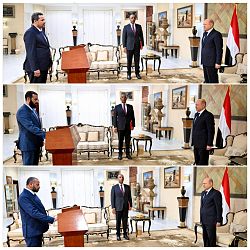
Governors of Lahj, Abyan, al-Dhalea governorates swear-in before President al-Alimi
The newly appointed governors of the governorates of Lahj Murad al-Halimi, of Abyan Dr. Mukhtar al-Rabbash and of al-Dhale Maj. General Ahmed al-Qubba took the constitutional oath today, Saturday, before His Excellency President Dr. Rashad a-Alimi, Chairman of the Presidential Leadership Council (PLC).

Republican Decrees Appoint New Governors
Republican decrees were issued on Thursday appointing new governors for the governorates of Lahj, Abyan, and Al-Dhalea.

Korea large companies' exports rise 10 percent
Large companies' exports in South Korea rose approximately 10 percent year-on-year in the fourth quarter of last year, driven by increased global demand for semiconductors.

Saudi League: Al-Nassr, Al-Ettifaq and Neom Secure Victories Over Al-Ittihad, Damac and Al-Riyadh
Al-Nassr defeated its guest Al-Ittihad 2–0 in the match that brought them together at Al-Awwal Park Stadium in Riyadh, as part of the 21st round of the Saudi Professional League.
Last Update: ،
2026/03/14
Time
11:21:08
Latest News:
 Governors of Lahj, Abyan, al-Dhalea governorates swear-in before President al-Alimi
Minister of Finance Discusses Economic Conditions, Support for Comprehensive Reforms with British Ambassador ..
Lt. Gen. al-Subaihi Discusses Efforts to Deter Terrorist Threats in the Region with the U.S. Ambassador ..
Promoting women participation very important for development—Al-Khanbashi stressed
Minister of Education Discusses with UNICEF Mechanisms to Strengthen Joint Cooperation
Latest News:
Governors of Lahj, Abyan, al-Dhalea governorates swear-in before President al-Alimi
Minister of Finance Discusses Economic Conditions, Support for Comprehensive Reforms with British Ambassador ..
Lt. Gen. al-Subaihi Discusses Efforts to Deter Terrorist Threats in the Region with the U.S. Ambassador ..
Promoting women participation very important for development—Al-Khanbashi stressed
Minister of Education Discusses with UNICEF Mechanisms to Strengthen Joint Cooperation
Minister Badhib emphasizes importance of strengthening coordination with partners
[25/02/2025 05:31]
RIYADH – SABA
Minister of Planning and International Cooperation Dr. Waed Badhib has emphasized the importance of enhancing close coordination with regional and international partners with the Yemeni government, represented by the Ministry of Planning.
This coordination aims to align donor interventions with national priorities.
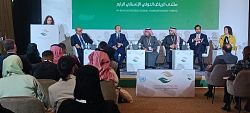
This statement was made during a dialogue session held Tuesday as part of the activities of the Fourth Riyadh International Humanitarian Forum, focusing on cooperation and developmental integration, as well as the mechanisms for collaboration between donor countries, international and local organizations and the Yemeni government.
The session aimed to highlight the efforts made and showcase the scale of contributions from donor countries and international and local organizations in cooperation with the legitimate government and international partners to achieve the desired goals.
It also discussed the challenges faced by donors and partners in implementing projects and overcoming these challenges while enhancing cooperation between donor countries, international and local organizations and the Yemeni government to achieve sustainable development goals.
Minister Badhib praised the efforts and support of the Saudi Program for Development and Reconstruction of Yemen, the King Salman Humanitarian Aid and Relief Center, the UN Resident Coordinator for Humanitarian Affairs in Yemen and all partners for Yemen on various fronts.
He pointed to the challenges Yemen faces in its economic, social, humanitarian, and institutional dimensions due to the war ignited by the Houthi terrorist militias, which has led to a loss of more than half of Yemen's national income, amounting to approximately $250 billion, a depreciation of the national currency by about 700%, and a cumulative inflation rate reaching 183%, with unemployment rising to 80%.
The Minister of Planning and International Cooperation noted that international and regional support for the country has taken two paths: humanitarian and developmental interventions together.
He addressed the government's priorities in achieving development and resilience through a short-term plan aimed at halting the deterioration of the economic situation, establishing the foundations of economic development, enhancing governance, and strengthening the private sector's resilience.
Badhib reviewed the medium-term priorities focused on the gains to be achieved from implementing urgent priorities that require coordinated efforts with stakeholders, especially from the government side, the private sector, civil society, and international partners.
These priorities include achieving economic recovery, financial and administrative reform, increasing economic growth rates, improving human development and sustainable development indicators, and raising the average income per capita.
Minister Badhib highlighted the role of Yemen's partners in supporting institutional reform of the government and aligning their interventions with national development plans to achieve a significant impact.
Key words:
SABA Minister - Reconstruction - administrative - contributions - approximately - collaboration - International - developmental - deterioration - organizations -
Governors of Lahj, Abyan, al-Dhalea governorates swear-in before President al-Alimi
Al-Mahrami Discusses with Governor of Dhalea Improving Services
Minister of Finance Discusses Economic Conditions, Support for Comprehensive Reforms with British Ambassador
Lt. Gen. al-Subaihi Discusses Efforts to Deter Terrorist Threats in the Region with the U.S. Ambassador
Promoting women participation very important for development—Al-Khanbashi stressed
Minister of Education Discusses with UNICEF Mechanisms to Strengthen Joint Cooperation
Planning Minister Discusses Expanded Cooperation with UNICEF and FAO
Yemen Stresses Unified Arab Position to Strengthen Development Role in Global Trade System
Japan and IOM Sign MoU to Fund Humanitarian Project in Marib Worth $5.3 Million
Prime Minister Affirms Government’s Commitment to Building Genuine Partnership with the Private Sector