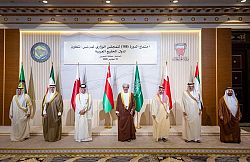
GCC's Ministerial Council Confirms its Support for Yemen's Unity, Sovereignty, Calls for Designating Houthi Militias Terrorist Group
The Gulf Cooperation Council (GCC) affirmed the sovereignty of the Republic of Yemen and the unity of its territory, calling on the UN Security Council to implement its resolutions regarding Yemen and the rebellion of the Iranian-backed Houthi terrorist militias.

GCC Secretary-General Welcomes UN Security Council’s Position on Houthi Attacks Against Saudi Arabia
The Secretary-General of the Gulf Cooperation Council (GCC) Jasem Albudaiwi has expressed his appreciation for the position conveyed by members of the United Nations Security Council in their presidential statement regarding the attacks carried out by the Houthi terrorist militia against the Kingdom of Saudi Arabia.

Brent Crude Futures Rise 12 Cents
Oil prices remained mostly unchanged in early Asian trading on Thursday following gains from the previous session and a sharp monthly increase.

Al Nassr Beat Al Fateh 3-0 in Saudi Football League
Al Nassr defeated Al Fateh 3-0 in the opening round of the Saudi Pro League, known as the Roshn Saudi League.
Last Update: ،
2026/10/19
Time
07:35:56
Latest News:
 Yemeni Ambassador Discusses Escalating Houthi Threats with US Assistant Secretary of State
Zouba, Indonesian Deputy Foreign Minister Discuss Cultural and Educational Cooperation
Government Calls on Security Council to Condemn Houthi Escalation in Yemen
Al-Soqatari, al-Sharjabi Participate in Operational, Technical Mission of Water and Irrigation Management ..
Parliament Speaker Praises Kuwait’s Support for Yemen
Latest News:
Yemeni Ambassador Discusses Escalating Houthi Threats with US Assistant Secretary of State
Zouba, Indonesian Deputy Foreign Minister Discuss Cultural and Educational Cooperation
Government Calls on Security Council to Condemn Houthi Escalation in Yemen
Al-Soqatari, al-Sharjabi Participate in Operational, Technical Mission of Water and Irrigation Management ..
Parliament Speaker Praises Kuwait’s Support for Yemen
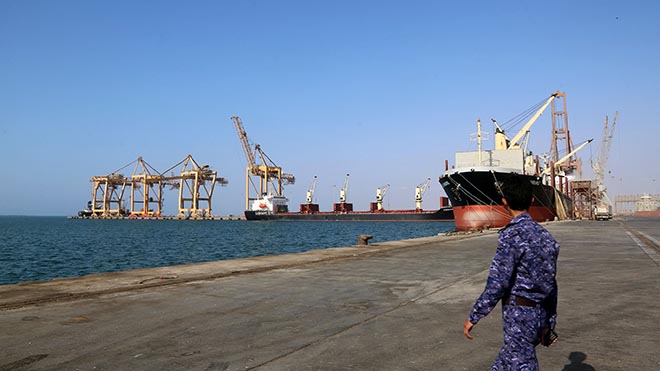
Houthi militia attacks on ships raising shipping prices and threatening famine
[20/01/2024 03:25]
ADEN – SABA
Economic experts warned of the disastrous continuity of Houthi attacks on ships, which led to a rise in ship insurance prices by 100 percent and may exceed that even more, as well as an unprecedented rise in shipping and maritime transport prices, which threatens a disaster for the countries surrounding the Red Sea, most notably Yemen, where it will be reflected.
This depends on the prices of goods and perhaps their lack.
The situation in the Red Sea and Bab al-Mandab is becoming dangerous with the continued attacks by the Houthi militia on commercial ships under the pretext of preventing Israeli ships or those linked to the Israeli entity from reaching them in light of the brutal Israeli attacks continuing for the third month in a row against the Gaza Strip and the Palestinian people.
The Minister of Industry and Trade, Muhammad Al-Ashwal told the Yemeni News Agency (Saba), "These attacks are a mobilization of communities affected by the Houthi behavior against Yemen, and the creation of unjustified hostilities while harming the regional economy of the countries bordering the Red Sea, and the rise in insurance prices and the rise in shipping costs.
"He added, "This will lead to an increase in the prices of food commodities, which may cause the import and export operations to stop if the repetition of these attacks increases.
"He said that the economic impact will be frightening in the long and short term, which will affect the lives and livelihoods of Yemenis through the rise in food prices and their disappearance, with the direct impact on the economic aspect represented by the collapse of the service sectors that accompany import and export business.
Al-Ashwal pointed out that the Yemenis are facing a catastrophe of a very different kind, represented by the partial or complete cessation of import and export operations for intermittent periods and the disruption of their systems, which affects small and emerging companies and leads to famine.
He stressed that the military actions by the terrorist Houthi militias in territorial waters will inevitably affect small-scale fishermen and thus the food security of Yemen and the livestock trade with the Horn of Africa and the export of vegetables to it.
The head of the Center for Studies and Economic Media, Mustafa Nasr, believes that the current crisis is heading towards an almost complete closure of trade in the Red Sea, whether through warnings from the US-led coalition to shipping companies or fears raised by the repeated Houthi militia attacks.
He said in a statement to the Yemeni News Agency (Saba), "The crisis in the Red Sea resulting from the Houthi attacks on ships was reflected in the rise in the cost of shipping and insurance on ships heading to Yemeni ports, and the price of the cost of shipping a 40-foot container to the port of Hodeidah rose from five thousand to ten thousand dollars.
Nasr added, "The same applies to the port of Aden, as the cost of shipping has increased by about 100 percent, and it is expected that it may reach 150 percent, and this will be directly reflected in the prices of goods."
He pointed out that traditional marine fishing operations, on which nearly one and a half million Yemenis depend, have declined and there is extreme caution about entering the sea to fish.
Key words:
SABA Economic - disappearance - unprecedented - intermittent - mobilization - catastrophe - surrounding - livelihoods - represented - frightening -
GCC's Ministerial Council Confirms its Support for Yemen's Unity, Sovereignty, Calls for Designating Houthi Militias Terrorist Group
Yemeni Ambassador Discusses Escalating Houthi Threats with US Assistant Secretary of State
Zouba, Indonesian Deputy Foreign Minister Discuss Cultural and Educational Cooperation
Government Calls on Security Council to Condemn Houthi Escalation in Yemen
Al-Soqatari, al-Sharjabi Participate in Operational, Technical Mission of Water and Irrigation Management Improvement Project in Yemen
Parliament Speaker Praises Kuwait’s Support for Yemen
Al-Khanbashi Praises UNDP Interventions in Hadramout
Iraqi Prime Minister Receives Foreign Minister
Yemen Welcomes European Council's Statement on Houthi Terrorist Militias' Escalation
Yemen Calls on OIC to Designate Houthi Militias as Terrorist Organization